The medical device industry operates under some of the most stringent quality controls in the world. When it comes to injection molding medical components—such as syringes, microfluidic chips, and surgical instruments—the margin for error is zero.
A successful production run requires a perfect synergy between medical-grade resins and advanced mold design. This guide breaks down the essential raw materials, steel selection protocols, and the eight critical mold system specifications required to pass strict Good Manufacturing Practice (GMP) audits.
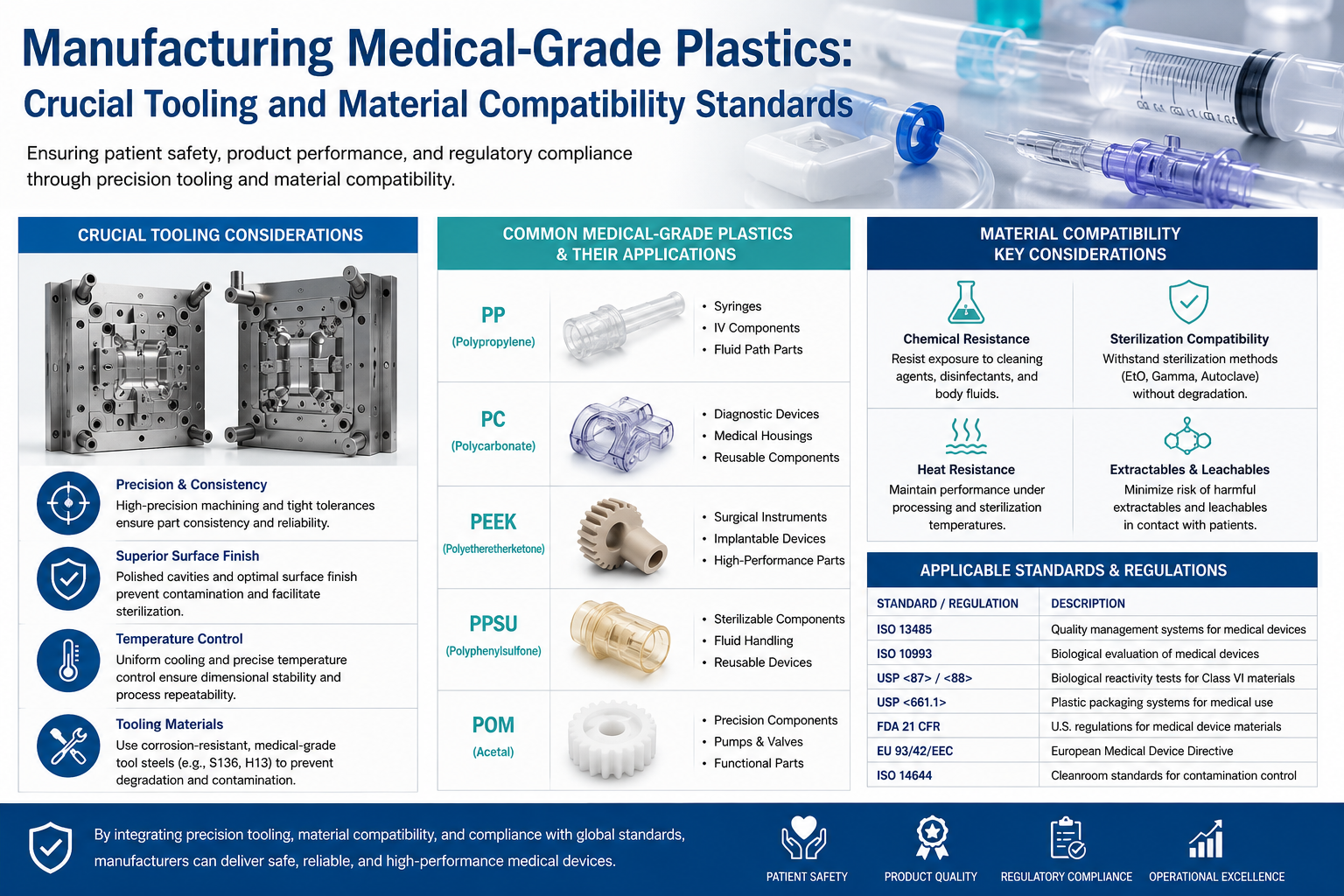
Different medical resins exhibit drastically different shrinkages, thermal stabilities, and optical requirements. The table below details the mainstream medical plastics and their corresponding mold design requirements.
| Material | Material Characteristics | Key Mold Design Requirements | Typical Applications |
| PP (Medical Grade) | EO steriliable, autoclave resistant, high shrinkage (1.6%–2.2%). | Uniform wall thickness, sufficient packing pressure, dense cooling channels, enlarged venting. | Syringe barrels, plungers, IV sets, consumable housings. |
| PC (Polycarbonate) | Ultra-high transparency, high impact resistance, autoclaveable, prone to hydrolysis. | Mirror-polished cavity, thorough material drying, shrinkage prevention, high venting. | Surgical instrument housings, dialyzers, blood collection cups. |
| COC / COP | Ultra-high transparency, low extractables, low protein binding, excellent biocompatibility. | S136 mirror steel, gate-vestige-free design, zero dead angles, low-shear hot runner. | Microfluidic chips, medical optical lenses, IVD test kits. |
| TPU (Medical Grade) | Flexible, soft elastomer, excellent sealing, highly prone to mold sticking. | Increased draft angles, high polish, anti-sticking surface treatments, balanced ejection. | Catheter jackets, sealing gaskets, negative pressure bulbs. |
| PPSU / PEEK | Resists repeated 134°C steam sterilization, high mechanical strength. | High-temperature mold steel, hot runners, wear-resistant inserts. | Scalpel handles, implantable device components. |
| PVC (Medical Soft) | Highly corrosive; decomposes to release chloride ions at high temperatures. | Must use stainless steel (S136/NAK80); ordinary 718 steel is strictly prohibited. | IV tube connectors, flexible tubing components. |
Corrosive Gas Decomposition: At high temperatures, materials like PVC and PC release corrosive gases that rapidly rust mold cavities. Pre-hardened carbon steels are strictly prohibited.
Zero Cosmetic Defect Tolerance: For transparent components (COC, PC), even a microscopic scratch, silver streak, or weld line results in immediate scrapping.
Zero Mold Release Spray: Residual chemical agents can contaminate drugs or biological samples. Molds must be designed with 100% self-demolding structures.
To prevent contamination from metal ions and ensure mold longevity against corrosive gases, material selection for medical molds follows strict compliance rules.
S136 / STAVAX 420 Stainless Steel (Top Choice): Offers exceptional acid/alkali corrosion resistance, superior mirror-polishing capabilities, and resistance to plastic decomposition gases. It can be electropolished and is typically hardened to HRC 48–52. This is the gold standard for optical-grade medical parts.
NAK80: Pre-hardened stainless steel. Ideal for medium-transparency components or parts requiring chemical texturing. No quenching required.
High-Temp Materials (PEEK/PPSU): Requires S136H combined with surface nitriding to enhance wear resistance under extreme temperatures.
Strictly Prohibited: 718H, P20, 45#, Cr12MoV, and ordinary carbon steels. These materials corrode easily when exposed to medical resins. The resulting rust and metal ion precipitation will contaminate medical fluids and fail GMP certifications.
Mold Base Plates: S50C base steel may be used, provided it never comes into contact with the plastic melt.
Moving Components: Slides, lifters, and inserts must be manufactured from S136 stainless steel.
Water Lines: All cooling line connectors, plugs, and nozzles must be made of Grade 304 or 316 stainless steel.
Electropolishing (EP): The highest medical standard. It eliminates microscopic crevices, creating a flawlessly smooth mirror finish that prevents bacteria accumulation and allows easy cleaning.
Vacuum Polishing: Reserved for transparent optical components.
Low-Temperature Nitriding: Enhances wear resistance without warping or degrading the mirror-polished finish.
Forbidden Treatments: Standard electroplating or hard chrome plating (risk of flaking and contamination) and TD coatings (risk of coating particle shedding).
The core objective is to eradicate resin debris, black spots, and material precipitation.
Gate Design Rules: Pinpoint gates (3-plate molds) or valve gate hot runners are highly preferred for syringes, blood tubes, and test kits to ensure zero gate vestige, zero debris, and zero stringing. Large side gates are prohibited because trimming creates micro-debris that poses a severe contamination risk.
Submarine Gates: Prohibited for transparent parts as they easily trap stagnant material, causing silver streaks or black spots.
Hot Runner Systems (Mandatory for High-End Medical): All hot runner components must be made of 316 stainless steel (Zero Copper, Zero Lead).
Valve Gates Only: Open nozzles are prohibited due to stringing and cold slug risks. Valve gates ensure precise volume control and clean shut-offs.
Internal Polishing: Hot nozzle internal channels must be mirror-polished to prevent carbon buildup.
Temperature Control: Accuracy must be within 1°C to prevent localized thermal degradation.
Design structures must eliminate bacterial breeding grounds and allow for flawless sterilization.
No Sharp Corners: All internal corners must have a radius of 0.5mm. Sharp right angles are notorious for harboring bacteria and will fail GMP audits.
Minimal Mating Gaps: Interlocking insert gaps must be 0.005mm. Interference fits are preferred over gapped assemblies to prevent material trapment.
Microscopic Smoothness: Both internal and external product surfaces must be electropolished to remove micro-grooves. Deep, narrow slots that are difficult to clean or sterilize must be avoided.
Medical parts demand ultra-tight dimensional tolerances 0.02mm to 0.05mm. Uneven cooling causes immediate warpage and wall thickness deviations.
Proximity: Cooling channels should be positioned 10–15mm away from the cavity, densely wrapping around both the core and cavity.
Slender Components: For syringe barrels and catheters, use spiral cooling channels or bubblers with baffles to achieve uniform core cooling.
Material: Channels must feature polished interiors and use 316 stainless steel connectors to prevent limescale and biofilm formation.
Zoned Regulation: Implement independent temperature circuits for the cavity, core, and hot runner system.
Medical resins degrade easily under high injection speeds. Poor venting is the number one cause of silver streaks, burn marks, and micro-voids.
Parting Line Venting: Venting slots should be 5–8mm wide and 0.008–0.015mm deep, encircling the entire perimeter of the cavity.
Auxiliary Venting: Add venting inserts at the base of ribs, deep cavities, and directly opposite the gate. Utilize the clearances of ejector pins and lifters for supplementary venting.
Multi-Stage Venting: Transparent COC/PC parts require specialized venting inserts with direct paths to the exterior of the mold to prevent carbon migration.
The goal is balanced ejection with zero pin marks, zero shedding, and zero scuffing.
Pin Specification: Ejector pins must be S136 stainless steel, mirror-polished.
Stripper Plates: For transparent cosmetic components (test kits, lenses), use stripper plates instead of pins to eliminate ejector marks entirely.
Tight Tolerances: The clearance between the ejector pin and the hole must be strictly controlled within 0.003–0.005mm. Anything wider causes micro-flashing; flashed plastic debris is a fatal defect in medical applications.
Contamination Prevention: Shaped or flat ejector pins are prohibited due to burr risks. Additionally, add grease catchers/stop buttons to prevent oil or dust from bouncing back into the mold cavity.
Material Choice: Sliders and lifters must be S136 stainless steel. Wear plates must use copper-free, self-lubricating materials (yellow brass is banned due to copper ion precipitation risks).
Dust Mitigation: Sliders must include dust-collection grooves on the retaining blocks to keep ambient cleanroom dust out of the molding area.
Lubrication: Moving components must exclusively use food-grade or medical-grade high-temperature synthetic grease. Standard industrial grease will outgas and contaminate the parts.
Cleanroom Guiding: Leader pins and guide bushings must be stainless steel and completely copper-free.
Precision Realignment: Incorporate side locks or taper locks to guarantee a mold-reclosing repeatability of 0.01mm, preventing any parting-line mismatch or flash.
Dust Caps: Guide bushings should be equipped with dust covers to isolate cleanroom particulates.
Medical injection molding typically occurs in Class 10,000 (ISO 7) or Class 100,000 (ISO 8) cleanrooms. The mold itself must not introduce particulates.
Perimeter Seals: Install dust-collection grooves and rubber gaskets along the outer perimeter of the mold parting line.
Enclosures: Add protective dust shrouds over the ejection plates and the exterior of slider mechanisms.
Medical Gaskets: All water line seals must utilize medical-grade silicone O-rings to prevent chemical leaching common with standard nitrile rubber.
Counter-Sunk Hardware: All screws on the mold exterior must be perfectly countersunk and flush. Exposed pockets or deep screw holes act as dust traps and are strictly prohibited.
 EN
EN



 Hot News